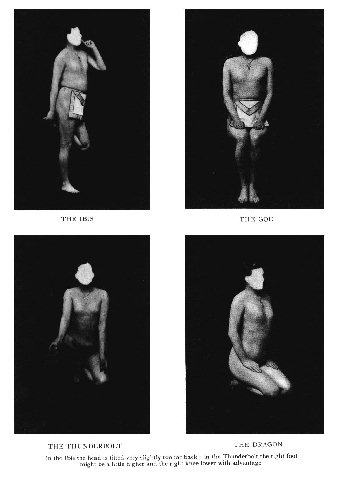
Cliff Berns posted this article on Yoga Postures and Forceful Yoga: Tibetan Amrtasiddhi Texts by Amoghavajra that was published earlier this year in Journal of Yoga Studies. Aleister Crowley made some study of the Yoga being taught in Europe around the turn of the past century, , incorporated those teachings into the curriculum of his own magical Order, the A.’.A.’. and wrote a series of eight essays on the subject. The Abstract of this particular paper reads:
The Amṛtasiddhi is a text that has recently become better known to people who are interested in the study and practice of yoga, especially Haṭha Yoga. This 11th-century text, by Mādhavacandra, is now considered to be the earliest text that teaches some of the mainpractices of Haṭha Yoga. Scholars now include the Amṛtasiddhi in the category of early haṭhayoga texts. This paper is based on the Tibetan Amṛtasiddhi corpus (’Chi med grub pa’i yig sna) composed by Amoghavajra but attributed to Virūpa. Although the Amṛtasiddhi and Haṭha Yoga might be thought to belong to separate traditions, namely Buddhist and Hindu, they nevertheless share some common practices. This paper was prompted by seeing descriptions of some yoga postures in the Tibetan Amṛtasiddhi corpus, which contains physical yoga practices that bear some resemblance to the āsanasof the Haṭha Yogatradition. These texts on the practice of physical yoga, or trulkhor texts, are written in verse form. They are mainly instructions on how to form various simple and complex body postures, often followed by specific breathing techniques and movements. In these posture-oriented yoga practices, the body posture (lus gnad) and the breathing technique (rlung gi gnad) are the main elements. Amoghavajra uses the Tibetan term lus gnad for these physical forms of yoga and drag po’i sbyor ba (forceful yoga) for one of the breathing techniques involved in this practice. Drag po’i sbyor ba is one of the Tibetan equivalents for the Sanskrit term haṭhayoga. In this paper, I will discuss the usage of the term lus gnad in Amoghavajra’s Amṛtasiddhi corpus and will present some of the selected Haṭha Yoga-like body postures. I will also discuss what this “forceful yoga” is.
Read the entire piece:
https://journalofyogastudies.org/index.php/JoYS/article/view/106/JoYS.V6.002