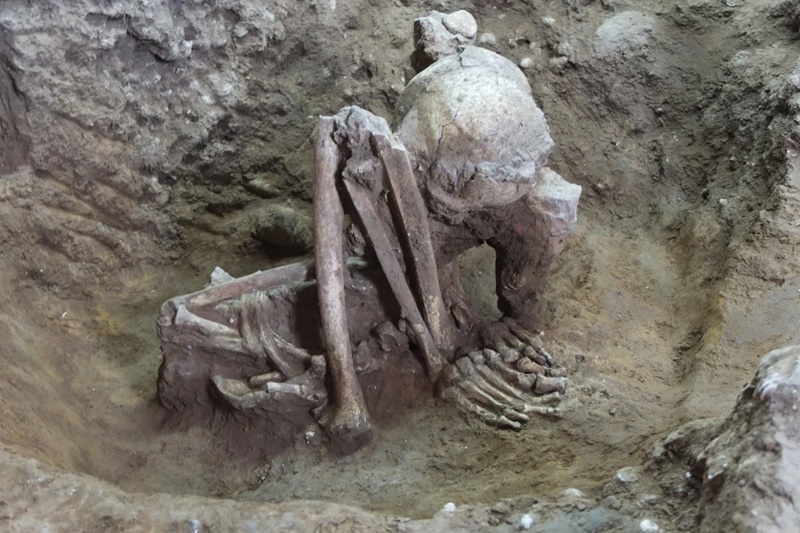
The scientific journal, Proceedings of the National Academy of Sciences, recently ran a feature regarding discovery of the earliest human bodies, specially prepared in order to preserve them, these remains being found in the People’s Republic of China. The Abstract reads:
In southern China and Southeast Asia (collectively, Southeastern Asia), Terminal Pleistocene and Early to Middle Holocene (ca. 12,000 to 4,000 cal. BP) hunter-gatherer burials feature tightly crouched or squatting postures, sometimes with indications of post-mortem dismemberment. Such burials contrast strongly with the extended supine burial postures typical of subsequent Neolithic inhumations in these regions. Their contorted postures, often with traces of burning, present interpretive challenges. This study uses multiple techniques, including X-ray diffraction and Fourier-transform infrared spectroscopy, to investigate 54 pre-Neolithic burials from 11 archaeological sites located across Southeastern Asia. The findings confirm that many of these pre-Neolithic flexed and squatting burials were treated by an extended period of smoke-drying over fire, a process of mummification similar to that recorded ethnographically in some Australian and Highland New Guinea societies. Some of the analyzed archaeological samples represent the oldest known instances of such artificial mummification in the world.
read the entire article:
https://www.pnas.org/doi/10.1073/pnas.2515103122#sec-5
Thanks to Soror Amy for the tip!